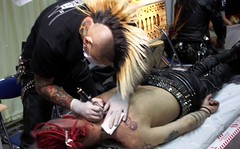
- Image by megabn via Flickr
While I suppose it would be plausible for other circuits to deal with tattoos as political speech, it’s really no surprise that it was the the U.S. Court of Appeals for the Ninth Circuit, in Anderson v. City of Hermosa Beach, that actually did. And that found them to be speech.
Some legal context before a piece of the opinion: the First Amendment right to Free Speech is not unlimited. Government can, in certain situations, regulate speech, and you see those situations referenced in the following section from the opinion, by Judge Bybee:
In sum, we hold that the tattoo itself, the process of tattooing, and the business of tattooing are forms of pure expression fully protected by the First Amendment. We further hold that the City’s total ban on tattoo parlors in Hermosa Beach is not a reasonable “time, place, or manner” restriction because it is substantially broader than necessary to achieve the City’s significant health and safety interests and because it entirely forecloses a unique and important method of expression. Moreover, no genuine issue of material fact exists with respect to the constitutionality of the regulation. Thus, we hold that Hermosa Beach Municipal Code § 17.06.070 is facially unconstitutional to the extent that it excludes tattoo parlors, and we reverse the district court’s order granting summary judgment in favor of the City and remand with instructions to grant Anderson’s motion for summary judgment and enjoin the City to include tattoo parlors in its zoning regulations.
Jonathon Alder, at the Volokh Conspiracy, included, in his review of the opinion, the concurring opinion of Judge Noonan, who wrote a separate concurring opinion:
I concur in the holding of the court, and I agree with Judge Bybee’s robust defense of the values protected by the First Amendment.
I write to state that tattooing may be purely expressive, not that it always is. Any text may be expressive but is not invariably so. A laundry list is normally not protected by the First Amendment, but William Carlos Williams made a grocery list into a poem. Context is all. A tattoo punitively affixed is unprotected.
Accepting the fact that a tattoo may qualify as protected speech, I note that creation of a tattoo may involve danger to the health of its recipient, so that tattooing requires regulation for health different from regulation, say, of a press. Tattooing as a business may also require regulation to assure that it does not attract minors. Finally, while we are bound to protect the First Amendment value at issue, we are not bound to recognize any special aesthetic, literary, or political value in the tattooist’s toil and trade.
(thx to How Appealing, via The Volokh Conspiracy)
Related articles by Zemanta
- Tattoos as Speech (volokh.com)
- Ninth Circuit Says First Amendment Protects the Right to Tattoo (loweringthebar.net)
- “Lawsuits: Court Rules Hermosa Beach Has to Allow Dumb Kids to Get Tattoos They’ll Regret” and related posts (la.curbed.com)
- “We hold that tattooing is purely expressive activity fully protected by the First Amendment” (reason.com)
- Court: Tattoo parlors covered by 1st Amendment (sfgate.com)
- Tattoo You! Ninth Circuit Gives Practice Gets First Amendment Protection (blogs.wsj.com)


 About Daniel Burton


 RSS - Posts