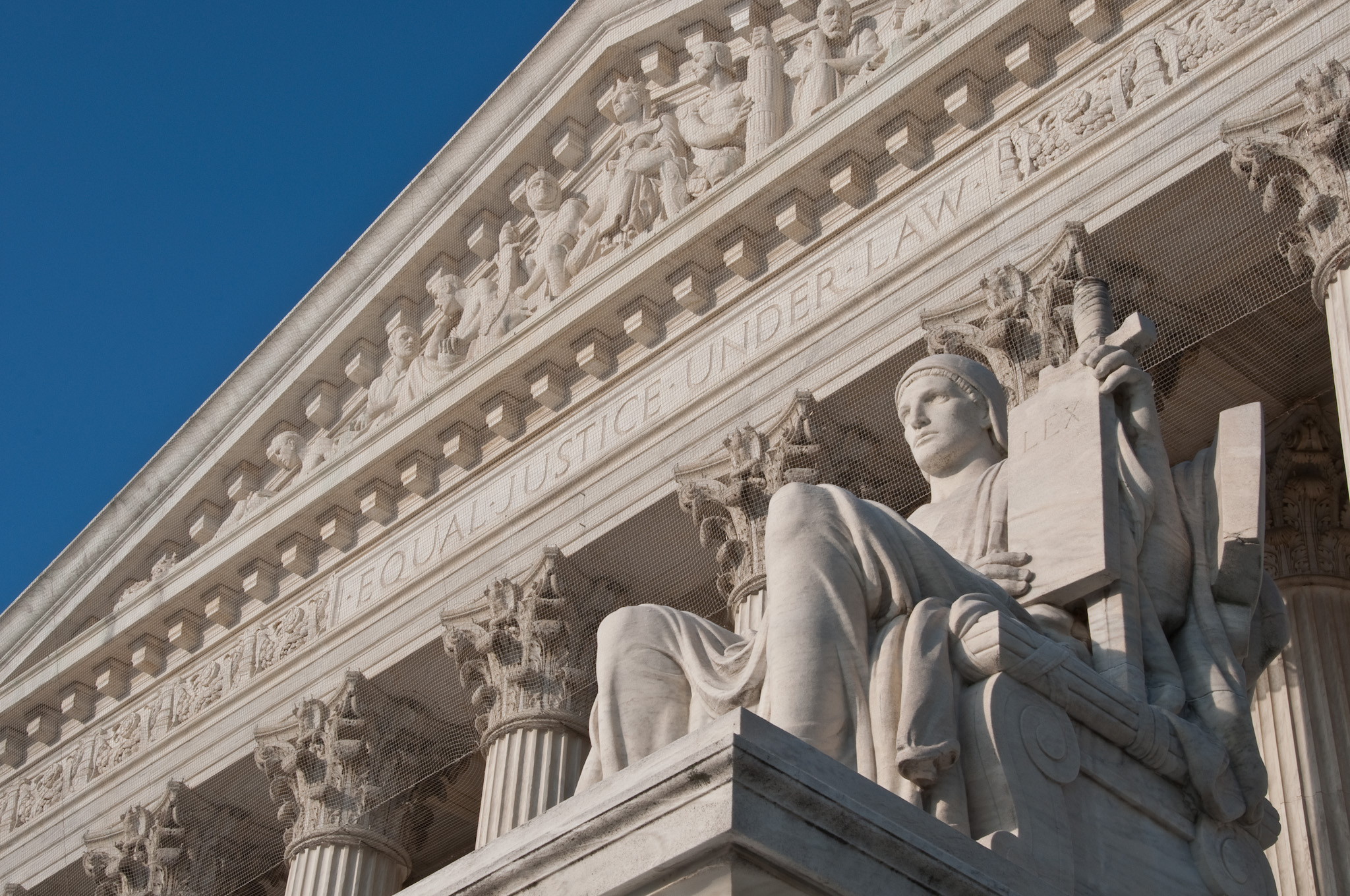
“The Guardian” or “Authority of Law” statue by James Earle Frasier in front of the United States Supreme Court building in Washington, DC. (Wikipedia)
When you ask a girl to the prom and she says no, you have a pretty good idea she simply doesn’t like you. Now, maybe she has a legitimate excuse, but, let’s be honest, “I have to visit my grandma” really isn’t all that legitimate. She’s just not that into you, dude. Deal with it. Move on. There are more fish in the sea, and other such clichés.
Well, there might be other fish in the dating sea, but there is only one real fish in the American legal sea: the Supreme Court of the United States (SCOTUS). If SCOTUS rejects you, you ain’t got nowhere else to go. Oddly, however, when SCOTUS says no, it doesn’t mean she doesn’t like you — honestly.
So, why the analogy? Well, because media outlets continually talk about SCOTUS declining to hear a case (a.k.a., denying a writ of certiorari, a.k.a., denying cert) as if that denial meant something about the case. The usual implication is the case would have lost summarily on the merits, so SCOTUS didn’t even bother with it.
For example, SCOTUS recently denied cert in a controversial New Mexico religious freedom/free speech case: Elane Photography v. Willock. The case was straightforward. New Mexico photographers were asked to photograph a gay commitment ceremony. Feeling a religious compunction against celebrating and advertising such an event, the photographers declined. The New Mexico Human Rights Commission determined the photographers broke the law by discriminating against gays because of their sexual orientation and fined them over $6000. The photographers disagreed, and took the case to court. The photographers lost in the New Mexico Supreme Court, and were told, among other things, that the rule of law required them “to compromise the very religious beliefs that inspire their lives.”
In the media, SCOTUS’s denial is sometimes portrayed as I noted above: this case is so simple it didn’t need to be heard. However, such an assumption is unwarranted.
As far back as 1923, SCOTUS noted that “[t]he denial of a writ of certiorari imports no expression of opinion upon the merits of the case, as the bar [i.e., lawyers in general] has been told many times.” United States v. Carver. SCOTUS reaffirmed this principle in 1995 in Missouri v. Jenkins.
And why doesn’t a denial of cert import an expression of opinion upon the merits of a case? SCOTUS addressed this very question in another case: Maryland v. Baltimore Radio Show. Here are just some of the reasons why SCOTUS might not grant cert (these are direct quotes from Maryland):
- Review may be sought too late
- Judgment of the lower court may not be final
- It may not be the judgment of a state court of last resort
- The decision may be supportable as a matter of state law, not subject to review by this Court, even though the state court also passed on issues of federal law
- A case may raise an important question, but the record may be cloudy
- It may be desirable to have different aspects of an issue further illumined by the lower courts

United States Supreme Court building. From Wikipedia, the free encyclopedia.
Other reasons may include the following: SCOTUS has recently ruled on a similar case, the Justices feel more important cases need to be heard that term, or such a case is too highly politically charged to decide during that term.
So, why do some media organizations assume cases are denied cert because they lack merit? Well, they may want to insinuate the cases are without merit. (When you lack actual facts to make an argument, you can always use baseless implication.) A more likely explanation, however, is most journalists writing about legal decisions aren’t lawyers and have never read the following quote from Justice Frankfurter:
[T]his Court has rigorously insisted that such a denial [i.e., denials of cert] carries with it no implication whatever regarding the Court’s views on the merits of a case which it has declined to review. The Court has said this again and again; again and again the admonition has to be repeated.
So, keep in mind that when SCOTUS says she doesn’t want to go out with you, it may be because she really is visiting her grandma.
Related articles
- SCOTUS Signals That It Doesn’t Care About Religious Liberty (politicaloutcast.com)
- Alliance Defending Freedom Launches Money Beg After Rejection By SCOTUS (joemygod.blogspot.com)


 About Marco Brown


 RSS - Posts